
Guide · Space Economy
Best Space ETFs: How to Invest in the Space Economy Without Betting on One Stock
SpaceX’s blockbuster listing turned space from a niche theme into the market’s main event — but you don’t have to shoulder single-stock risk to own the trend. Here are the space ETFs investors are actually using, what each one really holds, and the honest trade-offs between them.
Space ETFs — At a Glance
- Funds Covered
- 5
- Lowest Fee
- 0.40%ITA
- Largest Fund
- $6.5BITA
- Best 1-Yr Return
- +101%UFO
- Space Economy by 2035
- $1.8Tproj.
Why an ETF Instead of Just Buying SPCX?
It’s a fair question now that anyone can buy SpaceX stock directly. The answer is concentration: SPCX debuted at a record valuation with a wide range of credible outcomes — analyst targets span $63 to $190 — and a single launch failure, lock-up wave, or Musk headline can move it violently. A space ETF spreads that risk across launch providers, satellite operators, defense primes, and component makers, so one bad quarter from one company doesn’t define your position. The trade-off is equally honest: diversification dilutes the upside if SpaceX specifically is the winner you believe in.
The sector backdrop is what draws investors to either route: commercial space backlogs have passed $500 billion, and projections put the space economy at roughly $1.8 trillion by 2035.
The Best Space ETFs Compared
| Fund | Ticker | Expense Ratio | Style | Best for |
|---|---|---|---|---|
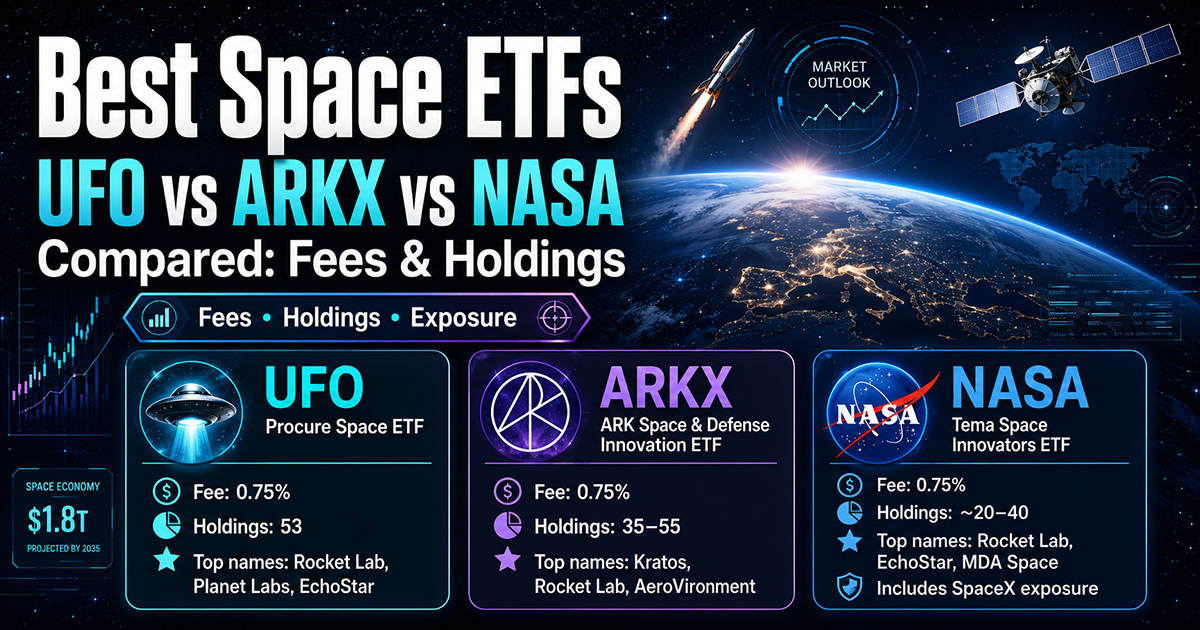
| Tema Space Innovators | NASA | 0.87% | Active, full space value chain | SpaceX-era momentum, largest dedicated space fund |
| Procure Space | UFO | 0.75% | Index, pure-play space | Direct exposure to companies earning revenue from space |
| ARK Space & Defense Innovation | ARKX | 0.75% | Active, space + adjacency | Believers in active management and the ARK approach |
| SPDR S&P Kensho Final Frontiers | ROKT | 0.45% | Index, space + deep sea | Lowest cost among space-focused funds |
| iShares U.S. Aerospace & Defense | ITA | 0.40% | Index, defense-heavy | Cheapest, most liquid space-adjacent exposure |
Tema Space Innovators ETF (NASA) — the SpaceX-era breakout
The cleverly tickered NASA fund became the story of the space-ETF race around the SpaceX listing, gathering roughly $2.6 billion in two months as retail investors used it as a vehicle for SpaceX exposure. It’s actively managed across the full space value chain, which is why it carries the highest fee here at 0.87%. The bet you’re making: a dedicated stock picker earns that fee in a sector where the gap between winners and losers is enormous.
Procure Space ETF (UFO) — the pure play
UFO tracks an index of companies with material revenue from space — Rocket Lab, MDA Space, Viasat, Planet Labs, and about 50 names total, with meaningful international exposure (Japan, Canada, Luxembourg) that US-only funds miss. It posted the strongest recent run of the group, up roughly 101% over the trailing year, with about $1.3 billion in assets and a 0.75% fee. The flip side of pure-play concentration: smaller-cap holdings make it the most volatile fund on this list.
ARK Space & Defense Innovation ETF (ARKX) — the active stock picker
Cathie Wood’s entry holds a concentrated ~33-name portfolio spanning orbital aerospace, enabling technologies, and adjacencies like AI and 3D printing — top holdings include Rocket Lab and L3Harris, with the top ten making up nearly 60% of assets. Around $1 billion in AUM, 0.75% fee, and returns that have trailed UFO’s, which is the cost of its broader diversification into names like Amazon and Deere that purists wouldn’t call space stocks at all.
SPDR S&P Kensho Final Frontiers ETF (ROKT) — the value pick
ROKT uses S&P’s Kensho AI methodology to select companies driving innovation in space and deep-sea exploration, weighted just over half toward aerospace and defense. At 0.45% it’s the cheapest space-focused option, with strong recent performance — the catch is small fund size and light trading volume, which means wider spreads and liquidity worth checking before placing large orders.
iShares U.S. Aerospace & Defense ETF (ITA) — the institutional route
ITA isn’t a space fund strictly speaking — it’s the giant of aerospace and defense, with $6.5 billion in assets, the lowest fee here at 0.40%, and deep liquidity. You’re buying space exposure bundled with fighter jets and missile programs, which is dilution to a space purist and a feature to anyone who sees defense spending and the space buildout as one combined thesis.
How to Buy a Space ETF
ETFs trade exactly like stocks: open a brokerage account, search the ticker, and buy full or fractional shares with no commissions at any major broker. Because thematic funds swing hard — 30–50% moves in short periods are normal for this sector — they’re best treated as a satellite allocation around a diversified core, not the core itself, and dollar-cost averaging suits them well.
Ready to Add Space to Your Portfolio?
Robinhood offers commission-free trading on all the ETFs above plus SPCX itself, with fractional shares from $1 — and a free stock bonus when you join through a referral.
Get Your Free Stock on Robinhood → Referral link — Wall Street Wit may receive a reward if you sign up and fund an account. Terms apply on Robinhood’s site. Not investment advice.Will Space ETFs Add SpaceX Stock?
This is the question that will reshape every fund on this list. With MSCI confirming early-inclusion rules for SPCX, index-tracking funds gain a path to add the stock quickly, and actively managed funds like NASA and ARKX can buy at their managers’ discretion. As SPCX enters portfolios, the line between “space ETF” and “SpaceX fund with extras” will blur — check each fund’s current holdings on the issuer’s site, because this is moving faster than any article can track. For the single-stock route instead, our guide covers how to buy SPCX directly, and if it’s specifically the satellite internet business you want, read whether you can buy Starlink stock separately.
Get the Next IPO Alert Before It Pops
The space economy’s next public debuts are coming — and so are OpenAI and Anthropic. Keep an eye on our upcoming IPOs tracker, and join the free Wall Street Wit IPO Watch list for a plain-English breakdown of every major debut before the first trade.
Frequently Asked Questions
What is the best space ETF?
There’s no single best — it depends on what you want. UFO offers the purest space exposure and the strongest recent returns; NASA is the largest dedicated space fund with active management; ROKT is the cheapest space-focused option at 0.45%; ITA is the cheapest and most liquid overall but is defense-heavy rather than space-pure.
Do any ETFs hold SpaceX stock?
With SPCX now publicly traded and MSCI confirming early index-inclusion rules, both index and active funds have a path to adding it — and active funds like NASA and ARKX can buy at any time. Check the current holdings list on each issuer’s website, as this is changing quickly.
Are space ETFs a good investment?
They’re high-risk, high-volatility thematic funds — 30–50% swings in short periods are normal, and a single launch failure can hit multiple holdings at once. The sector’s growth projections are real (roughly $1.8 trillion by 2035 in some estimates), but space ETFs belong in the satellite portion of a portfolio, not the core. Consider consulting a licensed financial advisor about your situation.
What’s the difference between UFO and ARKX?
UFO passively tracks an index of pure-play space companies and holds about 50 names including international stocks. ARKX is actively managed by ARK Invest with a concentrated ~33-stock portfolio that ranges into AI, 3D printing, and names like Amazon. UFO is the purer space bet; ARKX is a bet on ARK’s stock picking.
Should I buy a space ETF or SpaceX stock?
It’s a concentration decision. SPCX gives full exposure to SpaceX’s outcome — up or down — at a record-setting valuation. An ETF spreads risk across the sector but dilutes the SpaceX-specific upside. Many investors split the difference, holding a small direct SPCX position inside a broader ETF allocation. Neither answer is right for everyone.
Keep Reading on Wall Street Wit
Further Reading
Disclaimer: Wall Street Wit is a financial publisher, not a registered investment advisor, broker, or dealer. Nothing on this page constitutes investment, legal, or tax advice, or a recommendation to buy or sell any security or fund. Fund holdings, fees, assets, and performance figures change frequently and reflect publicly reported information at the time of writing; always verify current data on the fund issuer’s website. Past performance does not guarantee future results, and investing involves risk, including the possible loss of principal. Always do your own research and consider consulting a licensed financial professional before investing. This page contains referral and affiliate links; we may be compensated if you open an account or make a purchase through them, at no additional cost to you.