Guide · Private Markets
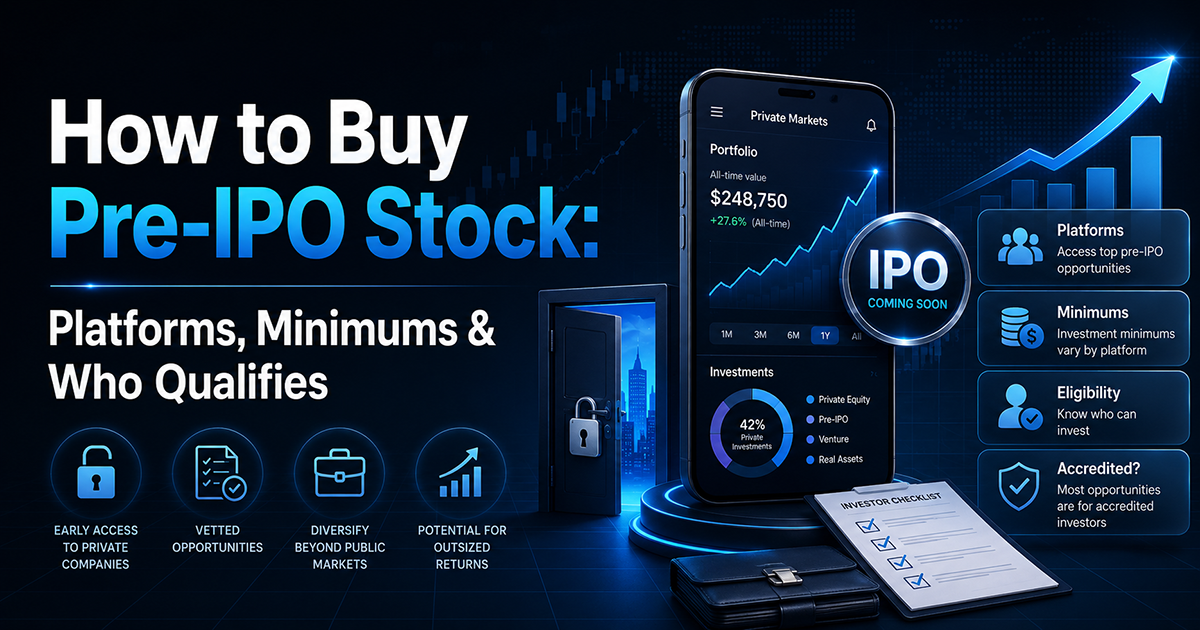
How to Buy Pre-IPO Stock: Every Route, From $30 to $100K Minimums
Investors who owned SpaceX before its record IPO just got the payoff everyone dreams about — and with OpenAI now confidentially filed for its own debut, the “how do I get in early” question is back with force. Here’s every legitimate way to buy pre-IPO stock, what each route costs, who qualifies, and the risks the pitch decks leave out.
Pre-IPO Access — The Landscape
- Cheapest Entry
- ~$301 share DXYZ
- Accredited Income Bar
- $200K/yr
- Or Net Worth
- $1Mex-home
- Marketplace Minimums
- $10K+
- Next Mega-IPO
- OpenAIfiled
Why Everyone Suddenly Wants Pre-IPO Shares
For most of stock market history, “getting in before the IPO” was a venture capitalist’s privilege. Then the proof of concept played out in public: investors who held SpaceX through funds and secondary marketplaces watched it go public in the largest IPO ever at a $1.78 trillion valuation. Days before that debut, OpenAI confidentially filed for its own IPO — and Anthropic is widely rumored to be next. The pipeline of private giants going public is the strongest it’s been in years, which is exactly why the pre-IPO access industry is booming.
One thing to internalize before any of the routes below: “pre-IPO” doesn’t mean “cheap.” Late-stage private shares often trade at rich valuations on secondary markets, and SpaceX’s own pre-IPO secondary price ran up dramatically before the listing. Early access is a bet that the public market will pay even more — sometimes true, frequently not.
The Accreditation Wall
US securities law splits the pre-IPO world in two. Most direct routes are restricted to accredited investors under SEC Rule 501: roughly $200,000 in annual income ($300,000 with a spouse) for the past two years, or $1 million in net worth excluding your primary residence. Platforms verify this — it’s not an honor system.
If you don’t clear that bar, you’re not locked out entirely. A handful of publicly traded funds were built specifically to give everyday investors a slice of private companies, and they’re where most people should start anyway.
Routes Anyone Can Use (No Accreditation)
Destiny Tech100 (DXYZ)
A closed-end fund listed on the NYSE that holds direct stakes in roughly two dozen top private tech companies — its largest positions have included SpaceX (pre-listing), Stripe, OpenAI, and Anthropic. Anyone with a brokerage account can buy a single share for around $30, no paperwork, no minimum. The famous catch: as a closed-end fund its market price floats free of its underlying net asset value, and DXYZ has traded at enormous premiums to NAV — meaning buyers sometimes pay several dollars for one dollar of actual private-company exposure. Check the premium before you buy, every time.
ARK Venture Fund (ARKVX)
ARK’s venture interval fund opens private-market access at around a $500 minimum. Interval funds only allow withdrawals at set windows each quarter — you trade liquidity for access, so treat it as locked-up money.
Fundrise Innovation Fund
Holds stakes in Anthropic, Databricks, OpenAI, Anduril, Canva, and other late-stage private names with low minimums and no accreditation requirement — currently one of the most direct ways for a regular investor to hold the AI labs before their IPOs. Same liquidity caveat: redemptions are periodic, not on demand.
ERShares Crossover ETF (XOVR)
A true ETF that blends private and public holdings — its largest private position has been SpaceX at roughly a fifth of the fund — with the rest in ordinary public stocks. The most liquid option here, at the cost of the most diluted private exposure.
Routes for Accredited Investors
| Platform | Typical Minimum | How it works |
|---|---|---|
| EquityZen | ~$10K–$20K | Pooled funds that hold shares sold by employees and early investors; broad company menu, fund-style fees |
| Hiive | ~$25K+ | Marketplace where sellers list shares and buyers bid — among the most transparent live pricing in the space |
| Forge Global | ~$100K | The institutional-scale marketplace, with deep transaction data and indicative pricing on hundreds of private names |
| Nasdaq Private Market | Varies | Runs company-sanctioned liquidity programs and tender offers |
| SPVs (special purpose vehicles) | ~$25K–$50K | Pooled vehicles formed to hold one company’s shares; watch for management fees plus carry (often a cut of profits) |
Two practical notes from how these markets actually work. First, prices for the same company can differ meaningfully across platforms on the same day — serious buyers maintain accounts on more than one marketplace and compare the effective all-in price, not headline valuations. Second, hot companies restrict share transfers: OpenAI, for example, requires board-level approval for transfers, which is why most access routes through SPVs that already hold shares rather than direct transfers — and why your legal counterparty is the vehicle operator, not the company itself. Read the structure before the pitch.
The Adjacent Route: IPO Access at the Offering Price
There’s a middle path most people overlook: buying at the IPO price itself, before public trading begins. Brokerages with IPO access programs let retail customers request shares in upcoming offerings at the offer price — the same entry institutions get. SpaceX made this mainstream by deliberately reserving an unusually large slice of its IPO for retail investors, and the next mega-debuts are likely to follow that playbook. It’s not pre-IPO investing, but it captures the piece most retail investors actually want: getting in before the first-day pop, without accreditation or five-figure minimums.
Get IPO Access With a Free Brokerage Account
Robinhood’s IPO Access lets eligible customers request shares in participating IPOs at the offering price — plus commission-free trading and fractional shares for everything already public. Sign up through a referral and get a free stock bonus.
Get Your Free Stock on Robinhood → Referral link — Wall Street Wit may receive a reward if you sign up and fund an account. IPO share allocation is never guaranteed. Terms apply on Robinhood’s site. Not investment advice.The Risks the Pitch Decks Skip
- Illiquidity is the default. Private shares and interval funds can’t be sold on demand. Your exit is an IPO, an acquisition, or a periodic redemption window — and IPOs come with lock-ups on top.
- You may not own what you think. SPV structures mean you own a slice of a vehicle that owns shares, with the operator’s fees, carry, and decisions between you and the company.
- Valuations are opaque. Private companies don’t file quarterly reports. The price you pay reflects the last funding round and secondary-market sentiment, not audited public disclosure.
- Premiums and fees compound against you. NAV premiums on closed-end funds, platform fees, fund expense layers, and SPV carry all take bites before the underlying investment earns you anything.
- The IPO itself is no guarantee. Plenty of richly valued private darlings have gone public below their last private-round price. Getting in “early” at the wrong price is just losing money sooner. For a live case study in how the market reprices a famous name, see our SPCX scenario analysis.
Get the Next IPO Alert Before It Pops
OpenAI has filed. Anthropic is rumored. The next SpaceX-sized debut is a matter of when, not if. Keep an eye on our upcoming IPOs tracker, and join the free Wall Street Wit IPO Watch list for a plain-English breakdown of every major debut before the first trade.
Frequently Asked Questions
Can I buy pre-IPO stock without being an accredited investor?
Yes, indirectly — through publicly traded or low-minimum funds that hold private companies, such as Destiny Tech100 (DXYZ), the ARK Venture Fund (ARKVX), the Fundrise Innovation Fund, or the XOVR ETF. Direct purchases on secondary marketplaces like Forge, Hiive, and EquityZen require accredited status.
What is an accredited investor?
Under SEC Rule 501, generally someone with about $200,000 in annual income ($300,000 jointly with a spouse) for the past two years, or $1 million in net worth excluding their primary residence. Certain professional licenses also qualify. Platforms are required to verify this.
Can I buy OpenAI stock before its IPO?
OpenAI has confidentially filed for an IPO but is still private. Accredited investors can pursue access through secondary platforms — typically via SPVs, since OpenAI requires board approval for share transfers. Non-accredited investors can get indirect exposure through funds like DXYZ or the Fundrise Innovation Fund that hold OpenAI stakes. Direct retail purchase isn’t possible until it lists.
What are the minimums to buy pre-IPO shares?
They range enormously: about $30 for one share of DXYZ, roughly $500 for ARKVX, around $10,000–$20,000 on EquityZen, $25,000+ on Hiive, $25,000–$50,000 for typical SPVs, and around $100,000 on Forge Global. Minimums change — verify on each platform.
Is pre-IPO investing worth it?
It can produce outsized returns when a company like SpaceX goes public above its private valuation — and meaningful losses when companies list below their last private price or never exit at all. The combination of illiquidity, opacity, fees, and premiums means it suits risk capital only. Consider speaking with a licensed financial advisor before committing money you may not see again for years.
Keep Reading on Wall Street Wit
Further Reading
Disclaimer: Wall Street Wit is a financial publisher, not a registered investment advisor, broker, or dealer. Nothing on this page constitutes investment, legal, or tax advice, or a recommendation to buy or sell any security or fund. Pre-IPO and private-market investments are speculative, illiquid, and may result in total loss; platform minimums, fees, eligibility requirements, and fund holdings change frequently and should be verified directly with each platform or issuer. Past performance does not guarantee future results. Always do your own research and consider consulting a licensed financial professional before investing. This page contains referral and affiliate links; we may be compensated if you open an account or make a purchase through them, at no additional cost to you.